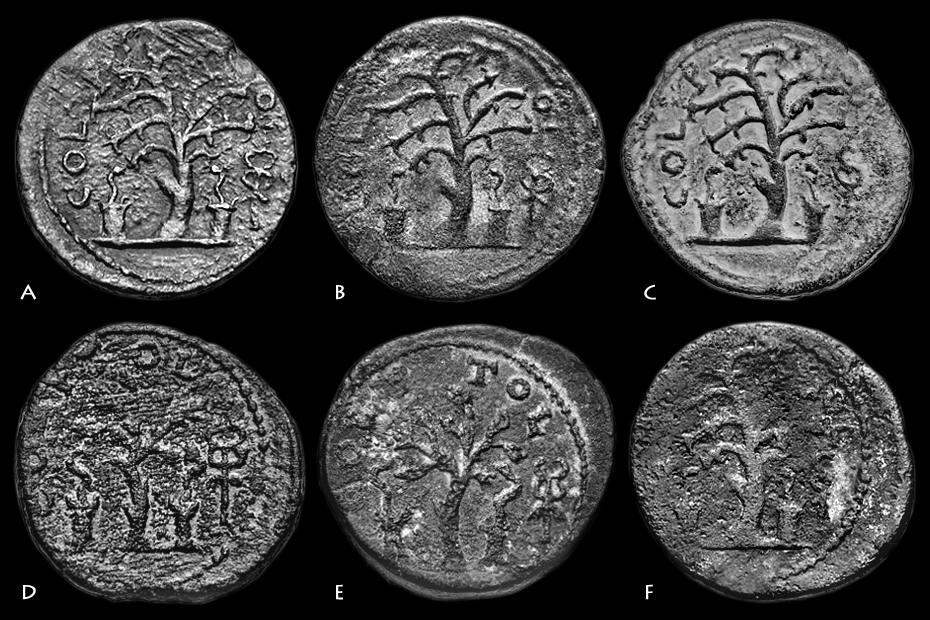
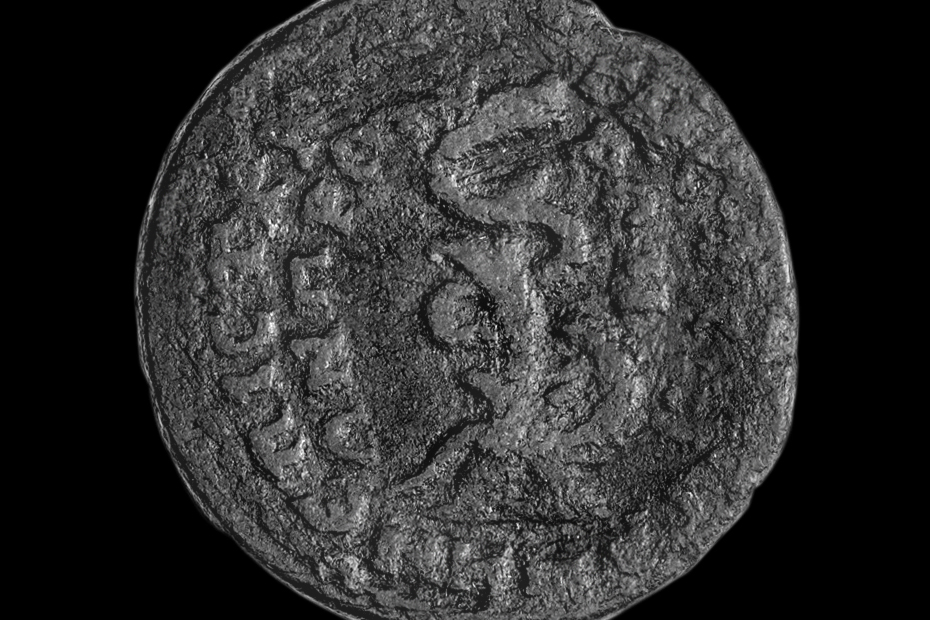
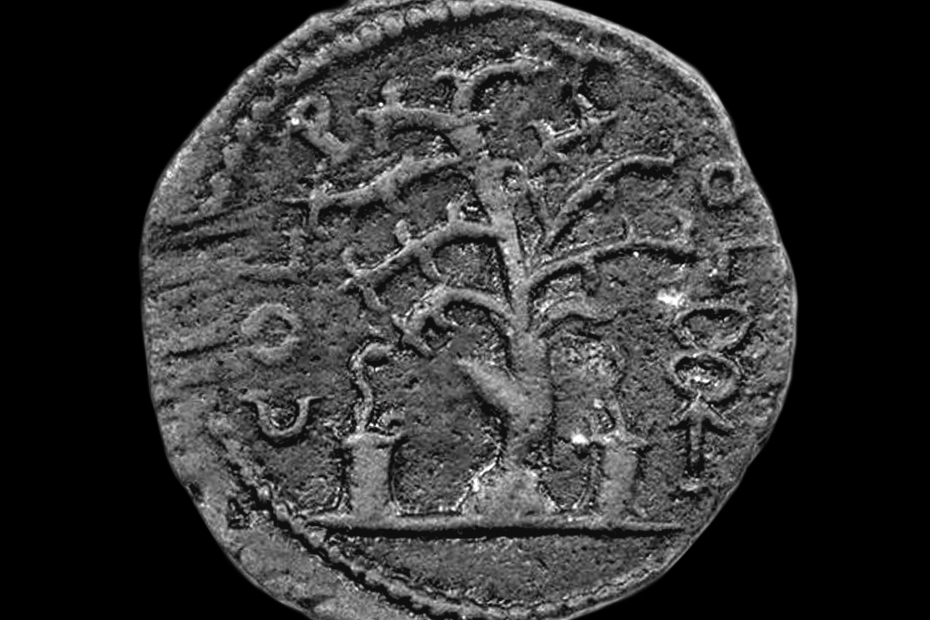
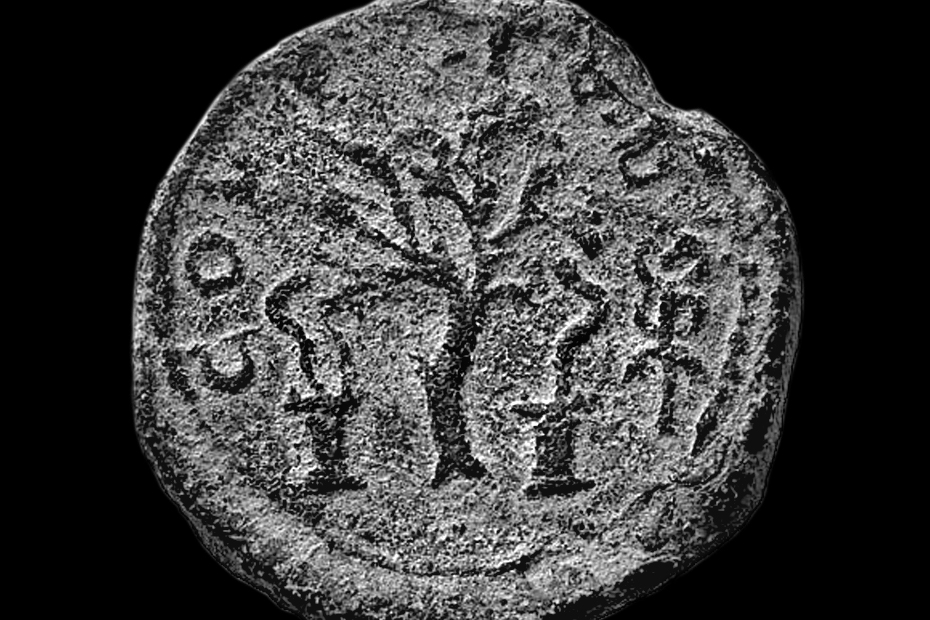
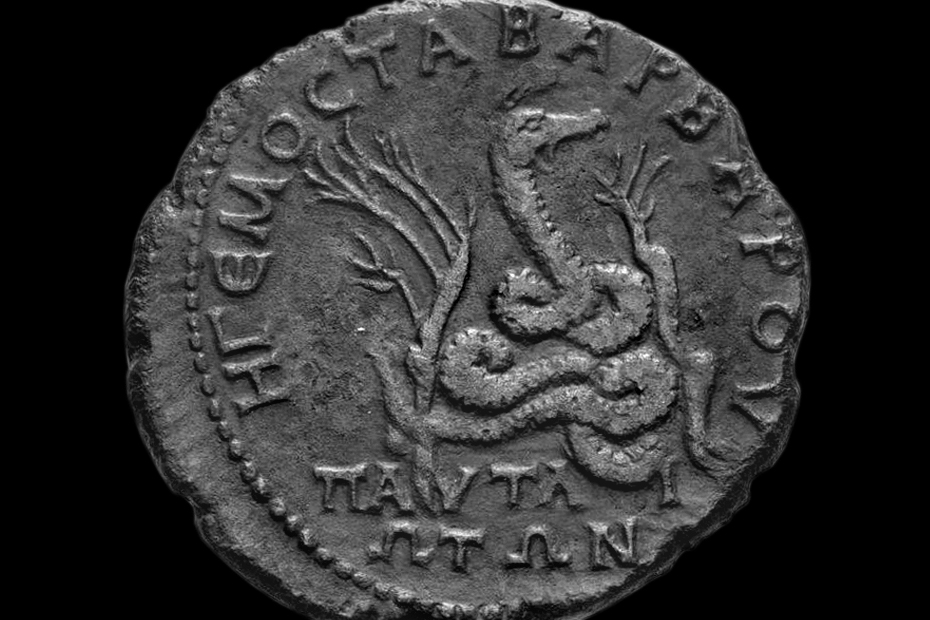
Set III-6-tre-001. In Greek and Roman mythology and iconography, trees were perennial plants revered for their longevity and usefulness. They served as powerful symbols of the cycle of birth, growth, death, and rebirth and were worshipped at the dedicated sacred groves, such as the oak one in Dodona. Silphium (Ferula communis, the giant fennel, laserwort, or laser) was a plant used in Classical Antiquity as a seasoning and as a medicine. It was the essential item of trade from the ancient North African city of Cyrene.
------------------------------------------------- « ● Selected Classical Quotations ● » --------------------------------------------------
“ It happened in Aulis (not, after all, so very long ago), when the Achaean fleet was gathering there with its load of trouble for Priam and the Trojans. We were sacrificing to the gods on their holy altars round a spring under a fine plane-tree, at the foot of which the sparkling stream gushed out, when a momentous thing occurred. A snake [δράκων] with blood-red markings on his back, a fearsome animal whom Zeus himself must have driven from his liar, darted out from below an altar and made straight for the tree. There was a brood of young sparrows on the highest branch, poor little creatures nestling under the leaves - eight birds in all, or nine counting the mother of the hatch. All of them, cheeping piteously and with their mother fluttering round and wailing for her little ones, were eaten by the snake [Ø]. He got the mother too; he coiled himself up and seized her by the wing as she came screaming by. But when he had devoured them all, mother and young, the god who had caused him to come out transformed him - he was turned into stone by the Son od Cronos of the Crooked Ways. And we stood gaping at the miracle. What could be meant by the intrusion on our holy rites of this portentous beast? Calchas interpreted the omen then and there. "Why are you dumbfounded," he said, "Achaeans of the flowing locks? It was for us that Zeus the Thinker staged this prophetic scene. We have waited for it long, and we shall have to wait for the sequel; but the memory of this day will not die. There were eight young sparrows, making nine with their mother, and all of these, mother and hatch, were eaten by the snake [Ø]. Nine, then, is the number of years that we shall have to fight at Troy, and in the tenth its broad streets will be ours." That is what Calchas prophesied; and all he said is coming true. Soldiers and fellow-countrymen, I call upon you all to stand your ground till we capture Priam's spacious town. „
● Homer (700s-600s BC), Iliad II: 303-332 | Translated by Emile V. Rieu. Copyright © 1950.
--------------------------------------------------------------------- « ● ● ● » ---------------------------------------------------------------------
“ Here [at Aulis] the most of the Greeks had prepared to offer the customary sacrifices to Jove; the fires on an ancient altar had duly been lit and the glowing coals were awaiting a victim, when all of the sudden the people noticed a blue-green serpent [draco] spiraling up a plane tree, close to the sacred precinct. Right at the top of the tree was a nest which contained eight fledglings. These were seized in the serpent's [serpens] fangs and greedily gulped down, before it devoured the mother bird as she fluttered around the chicks she was losing. The crowd was dumbfounded, but Calchas the prophet unfolded his vision: "Rejoice, you Greeks! We surely will triumph. Troy must fall, but our toil shall be long. These nine dead birds presage nine years of war!" The snake [serpens], still coiled in the tree's green branches, turned into stone in the form of a serpentine [Ø] sculpture. „
● Publius Ovidius Naso (43 BC - 17/18 AD), Metamorphoses XII: 011-022 | Translated by David Raeburn. Copyright © 2004.
--------------------------------------------------------------------- « ● ● ● » ---------------------------------------------------------------------
“ A serpent [δράκων] twisted his curving backbone about the tree, and sucked a strong draught of nectar trickling from the fruit; when he had milked the Bacchic potation with his ugly jaws, the draught of the vine turned and trickled out of his throat, reddening the creature's beard [!] with purple drops. The hill-ranging god marvelled, as he saw the snake [δράκων] and his chin dabbled with trickling wine: the speckled snake [ὄφις] saw Euios, and went coiling away with his spotty scales and plunged into a deep hole in the rock hard by. When Bacchus saw the grapes with a bellyful of red juice, he bethought him of an oracle which prophetic Rheia had spoken long ago. He dug into the rock, he hollowed out a pit in the stone with the sharp prongs of his earth-burrowing pick, he smoothed the sides of the deepening hole and made an excavation like a winepress; then he made his sharp thyrsus into the cunning shape of the later sickle with curved edge, and reaped the newgrown grapes. „
● Nonnus of Panopolis (late 300s-400s AD), Dionysiaca XII: 319-336 | Translated by William H. D. Rouse. Copyright © 1940.
--------------------------------------------------------------------- « ● ● ● » ---------------------------------------------------------------------
“ The nestlings of the Indian plane-tree are shrinking again in horror at the dragon's [δράκων] jaw-point, and thus they foretell war with Bacchos. „
● Nonnus of Panopolis (late 300s-400s AD), Dionysiaca XXV: 004-006 | Translated by William H. D. Rouse. Copyright © 1940.
--------------------------------------------------------------------- « ● ● ● » ---------------------------------------------------------------------
“ A great swarm had come from Areizanteia, nurse of the strange tree-honey; the trees drink the fruitful moisture of morning dew, and their leaves run honey, and so they produce the neat travail of the clever bee as if from a hive, the yellow juice born of the leaves alone [sugar-cane?] {...} Such honey Areizanteia brings: rejoicing in this, great flocks of birds swim on their wings and dance above the leaves; or a coiling serpent [ὄφις] creeps along, and girdles the sweet tree with enfolding loops, while he sucks the delicate juice with greedy mouth and licks with his lips the sweet travail of the clusters. So snakes [δράκων] dribble out the tree-juice and drop delicious honey, they spit out abroad more of the sweet sap of the bee than their own bitter scattering poison. „
● Nonnus of Panopolis (late 300s-400s AD), Dionysiaca XXVI: 183-188, 192-200 | Translated by William H. D. Rouse. Copyright © 1940.
--------------------------------------------------------------------- « ● ● ● » ---------------------------------------------------------------------
“ {...} he [Hephaistos] also portrayed {...} Moria, and the dappled serpent [ὄφις], and the divine plant, and Damasen Serpent-killer [δράκων] the terrible son of Earth; Tylos, also, who lived in Maionia so short a time, was there mangled in his quick poisonous death. Tylos was walking once on the overhanging bank of neighbouring Hermos the Mygdonian River, when his hand touched a serpent [δράκων]. The creature lifted his head and stretched his hood, opened wide his ruthless gaping mouth and leaped on the man, whipped round the man's loins his trailing tail and hissed like a whistling wind, curled round the man's body in clinging rings, then darting at his face tore the cheeks and downy chin with sharp rows of teeth, and spat the juice of Fate out of his poisonous jaws. The man struggled with all that weight on his shoulders, while his neck was encircled by the coiling tail, a snaky [ὄφις] necklace of death bringing Fate very near. Then he fell dead to the ground, like an uprooted tree. A Naiad unveiled pitied one so young, fallen dead before her eyes; she wailed over the body beside her, and pulled off the monstrous beast, to bring him down. For this was not the first wayfarer that he had laid low, not the first shepherd, Tylos not the only one he had killed untimely; lurking in his thicket he battened on the wild beasts, and often pulled up tree by the roots and dragged it in, then under the joints of his jaws swallowed it into his dank darksome throat, blowing out again a great blast from his mouth. Often he pulled in the wayfarer terrified by his lurking breath, and dragged him rolling over and over into his mouth - he could be seen from afar swallowing the man whole in his gaping maw. So Moria watching afar saw her brother's murderer; the nymph trembled with fear when she beheld the serried ranks of poisonous teeth, and the garland of death wrapped round his neck. Wailing loudly beside the dragon-vittling [δράκων] den, she met Damasen a gigantic son of Earth, whom his mother once conceived of herself and brought forth by herself. From his birth, Quarrel was his nurse, spears his mother's pap, carnage his bath, the corselet his swaddlings. Under the heavy weight of those long broad limbs, a warlike babe, he cast lances as a boy; touching the sky, from birth he shook a spear born with him; no sooner did he appear than Eileithyia armed the nursling with a shield [ἀσπίς]. This was he whom the nymph beheld on the fertile slope of the woodland. She bowed weeping before him in prayer, and pointed to the horrible reptile, her brother's murderer, and Tylos newly mangled and still breathing in the dust. The Giant did not reject her prayer, that monstrous champion; but he seized a tree and tore it up from its roots in mother earth, then stood and came sidelong upon the ravening dragon [δράκων]. The coiling champion fought him in serpent [ὄφις] fashion, hissing battle from the war-trumpet of his throat, a fifty-furlong serpent [ὄφις] coil upon coil. With two circles he bound first Damasen's feet, madly whipping his writhing coils about his body, and opened the gates of his raging teeth to show a mad chasm: rolling his wild eyes, breathing death, he shot watery spurts from his lips, and spat into the giant's face fountains of poison in showers from his jaws, and sent a long spout of yellow foam out of his teeth. He darted up straight and danced over the giant's high-crested head, while the movement of his body made the earth quake. But the terrible giant shook his great limbs like mountains, and threw off the weight of the serpent's [δράκων] long spine. His hand whirled aloft his weapon, shooting straight like a missile the great tree with all its leaves, and brought down the plant roots and all upon the serpent's [Ø] head, where the backbone joins it at the narrow part of the rounded neck. Then the tree took root again, and the serpent [δράκων] lay on the ground immovable, a coiling corpse. Suddenly the female serpent [ὄφις] his mate came coiling up, scrapping the ground with her undulating train, and crept about seeking for her misshapen husband, like a woman who missed her husband dead. She wound her long trailing spine with all speed among the tall rocks, hurrying towards the herb-decked hillside; in the coppice she plucked the flower of Zeus with her snaky [ἔχιδνα] jaws, and brought back the pain-killing herb in her lips, dropt the antidote of death into the dry nostril of the horrible dead, and gave life with the flower to the stark poisonous corpse. The body moved of itself and shuddered; part of it still had no life, another part stirred, half-restored the body shook another part and the tail moved of itself; breath came again through the cold jaws, slowly the throat opened and the familiar sound came out, pouring the same long hiss again. At last the serpent moved, and disappeared into his furtive hole. moria also caught up the the flower of Zeus, and laid the life-giving herb in the life-begetting nostril. The whole some plant with its pain-healing clusters brought back the breathing soul in to the dead body and made it rise again. Soul came into body the second time; the cold frame grew warm with the help of the inward fire. The body, busy again with the beginning of life, moved the sole of the right foot, rose upon the left and stood firmly based on both feet, like a man lying in bed who shakes the sleep from his eyes in the morning. His blood boiled again; the hands of the newly breathing corps were lifted, the body recovered its rhythm, the feet their movement, the eyes their sight, and the lips their voice. „
● Nonnus of Panopolis (late 300s-400s AD), Dionysiaca XXV: 451-552 | Translated by William H. D. Rouse. Copyright © 1940.
--------------------------------------------------------------------- « ● ● ● » ---------------------------------------------------------------------
“ On one of them [the Ambrosial Rocks] grows a spire of olive, their agemate, self-rooted and joined to the rock, in the very midst of the water-faring stone. On the top of the foliage you will see an eagle perched, and a well-made bowl. From the flaming tree fire self-made spits out wonderful sparks, and the glow devours the olive tree all round but consumes it not. A snake [ὄφις] writhes round the tree with its high-lifted leaves, increasing the wonder both for eyes and for ears. For the serpent [δράκων] does not creep silently to the eagle flying in high, and throw itself at him from one side with a threatening sweep to envelop him, nor spits deadly poison from his teeth and swallows the bird in his jaws; the eagle himself does not seize in his talons that crawler with many curling coils and carry him off high through the air, nor will he wound him with sharp-toothed beak; the flame does not spread over the branches of the tall trunk and devour the olive tree, which cannot be destroyed, nor withers the scales of the twining snake [δράκων], so close a neighbour, nor does the leaping flame catch even the bird's interlaced feathers. No - the fire keeps to the middle of the tree and sends out a friendly glow: the bowl remains aloft, immovable though the clusters are shaken in the wind, and does not slip and fall. "You must catch this wise bird, the high-flying eagle age-mate of the olive, and sacrifice him to Sea-blue-hair [Poseidon]. Pour out his blood on the sea-wandering cliffs to Zeus and the Blessed. Then the rock wanders no longer driven over the waters; but it is fixed upon immovable foundations and unites itself bound to the free rock. Found upon both rocks a builded city [Tyre], with quays on two seas, on both sides." „
● Nonnus of Panopolis (late 300s-400s AD), Dionysiaca XL: 469-500 | Translated by William H. D. Rouse. Copyright © 1940.
--------------------------------------------------------------------- « ● ● ● » ---------------------------------------------------------------------
“ Another [satyr, silenos, or maenad?] threw a snake [δράκων] at an oak; the snake [ὄφις] coiled round the tree, and turned into moving ivy [!] running round girdling the trunk, just as snakes [δράκων] run their coils round and round." „
● Nonnus of Panopolis (late 300s-400s AD), Dionysiaca XLV: 311-314 | Translated by William H. D. Rouse. Copyright © 1940.
| Editorial notes: {...} - Omitted text; [...] - Translation back to the original, clarification, or curator's commentary. |
|
|

 Search Functionality Demonstration