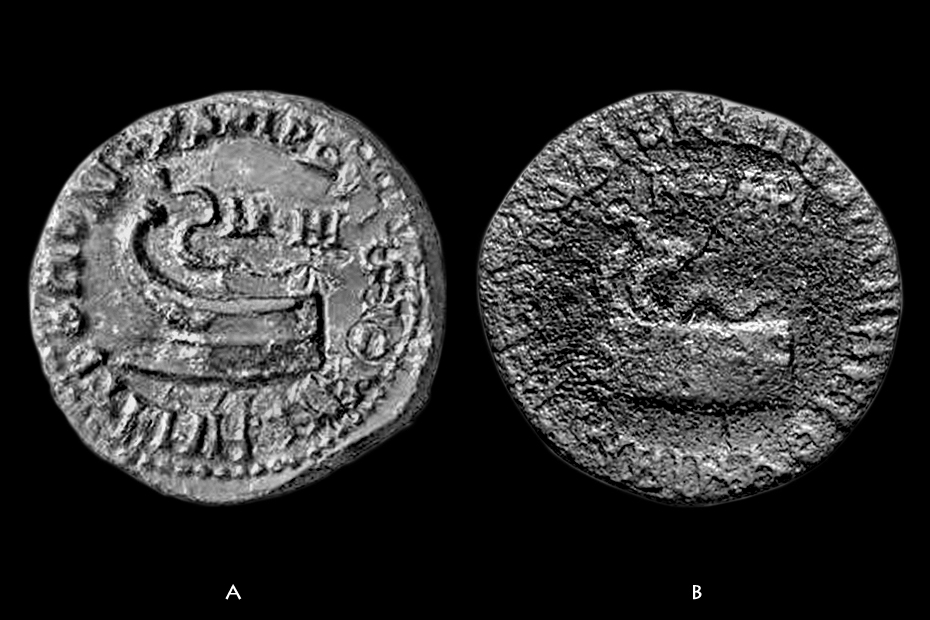
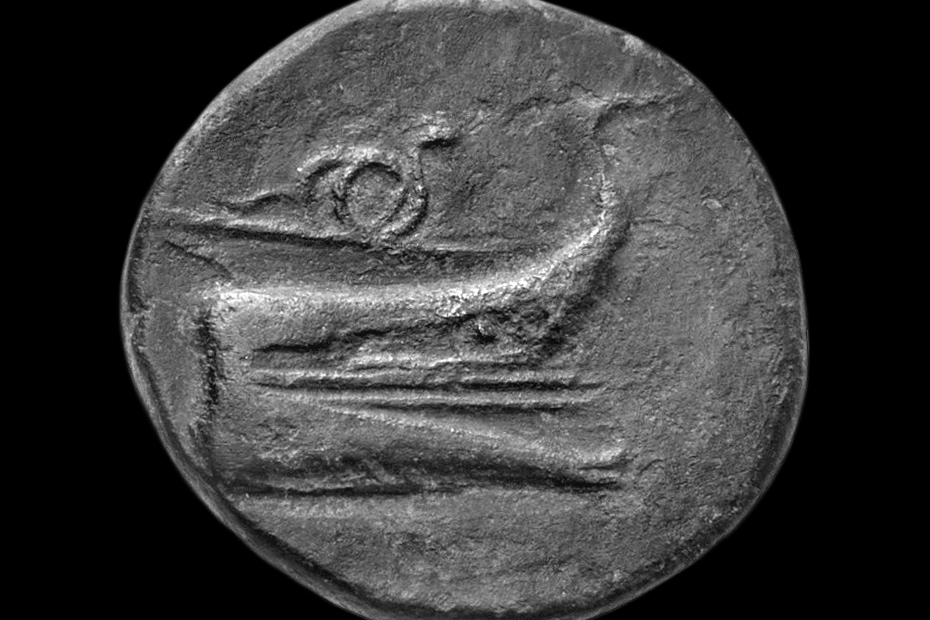
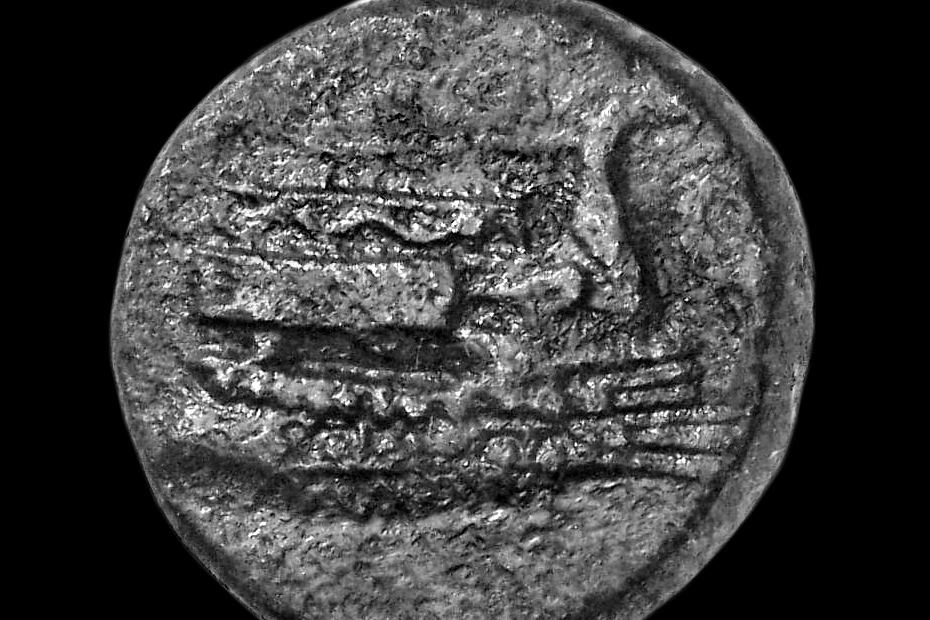
Set III-6-gal-001. In Greek and Roman mythology and iconography, galley was a type of warship that was propelled mainly by rowing. Virtually all types of galleys had sails that could be used in favorable winds, but human strength was always the primary method of propulsion, what allowed galleys to navigate independently of winds and currents. Different types of galleys (uniremes, biremes, triremes, etc.) were used by all of the early Mediterranean naval powers, including the Phoenicians, Egyptians, Greeks, and Romans.
------------------------------------------------- « ● Selected Classical Quotations ● » --------------------------------------------------
“ Mimnes, you who gape open all he way to the shoulders, don't paint again on a trireme's many-benched side a serpent [ὄφις] that runs from the ram to the helmsman; for this is a dangerous omen for the helmsman, you slave born of a slave ..., if the serpent [ὄφις] bites him on the shin. „
● Hipponax (fl. 540s BC), Testimonia: 28, Tzetzes on Antechomerica (In Greek Iambic Poetry: From the Seventh to the Fifth Centuries BC, LCL) | Translated by Douglas E. Gerber. Copyright © 1999.
--------------------------------------------------------------------- « ● ● ● » ---------------------------------------------------------------------
“ But when they [the Argonauts] had boarded their ship and, with a south wind blowing over the sea, began searching for passages to leave lake Triton, for a long time they had no plan and spent all day drifting aimlessly. And as a snake [δράκων] goes wriggling on its crooked way when the hottest light of the sun is scorching it, and with a hiss turns its head this way and that, and its eyes shine like sparks of fire in its agitation, until it enters its hole through a crevice - thus the Argo, in search of a navigable outlet from the lake, wandered about for a long time. „
● Apollonius Rhodius (200s BC), Argonautica IV: 1537-1547 | Translated by William H. Race. Copyright © 2008.
--------------------------------------------------------------------- « ● ● ● » ---------------------------------------------------------------------
“ Sergetsus {...} oars lost, one tier of them quite disabled, was bringing his vessel ingloriously to port, amid general laughter. As often occurs when a snake [serpens] has been caught on the hump of a high road, a bronze wheel running across it, or a wayfarer smashing it hard with a stone and leaving it there, crushed and half dead, the serpent [Ø] makes futile attempts to escape, wriggling its long body - part of it still defiant, eyes blazing, the neck reared upright and hissing; while part of it, crippled by injury, drags, lashing itself into knots and writhing back on its own coils. Something like this was the oarage working that sluggish vessel {...} „
● Publius Vergilius Maro (70-19 BC), Aeneid V: 268-280 | Translated by Cecil Day-Lewis. Copyright © 1952.
--------------------------------------------------------------------- « ● ● ● » ---------------------------------------------------------------------
“ From there the enormous serpent [Ø] slithered along a carpet of flowers spread over the ground, and went on his way through the city down to the port, which was fortified by a curving embankment. Here he halted and, turning round with a kindly expression, appeared to dismiss the escort of worshippers thronging behind him. Quickly he boarded and lay in the Roman ship, which felt the weight of the god and settled deeper into the water. The Romans joyfully offered a slaughtered bull on the shore, set garlands of flowers on the prow and unfastened the mooring cables. The ship was wafted along by a gentle wind. The snake-god [Ø] lifted his body aloft and rested his neck on the curved prow, gazing down on the blue below. On the mildest of breezes he crossed the Ionian Sea and, five dawns on, he arrived off Italy. {...} Here the crew directed the sailing ship to the shore as the sea turned rough. On landing the god unfolded his coils and, gliding along in voluminous folds with his sinuous spiral, he came to his father Apollo's temple adjoining the sands. When the spirit most close to himself had given him shelter until the sea had calmed down, the serpent [Ø] left the altar of Phoebus and furrowed the sand to the ship with the track of his rustling scales. He mounted the rudder and rested his head once more on the prow. Shortly he passed by Castrum, Inuus' camp, sailed on to Lavinium's sacred town and entered the mouth of the Tiber. Here on the banks he could see a crowd of commoners, matrons, elders, the virgins who watch the fires in the temple of Vesta, rushing to meet him and great his arrival with cheers of rejoicing. The ship moved swiftly upstream. On a row of improvised altars incense was smoking and crackling, perfuming the air on the two banks; knives and were dripping with blood, still warm, from sacrificed victims. And now he had entered the city of Rome, the world's great capital. Raising his serpent's [serpens] body aloft and supporting his neck on the top of the mast, the god looked round for a home that would suit him. He'd come to a point where the Tiber divides and its waters encircle a plot which is known as the Island; the river extends its arms in an equal embrace to either side of the land it's surrounding. Here the serpent-son [anguis] of Apollo abandoned the Latian pine ship and landed. „
● Publius Ovidius Naso (43 BC - 17/18 AD), Metamorphoses XV: 688-700, 719-742 | Translated by David Raeburn. Copyright © 2004.
--------------------------------------------------------------------- « ● ● ● » ---------------------------------------------------------------------
“ That which is said to have happened in Lycia sounds like a myth, yet it has some supporting testimony in the tales that are told. Amisodarus, as they say, whom the Lycians call Isaras, arrived from from the Lycian colony in the vicinity of Zeleia, bringing with him pirate ships, in command of which was Chimarrhus, a warlike man, bloodthirsty and brutal. He sailed in a vessel which had a lion as its figurehead at the prow, and a serpent [δράκων] at the stern. He did much evil to the Lycians, and it was not possible to sail the sea or even to live in the cities near the sea. This man Bellerophon slew, pursuing him with Pegasus as he was trying to escape. „
● Lucius Mestrius Plutarchus (46-120 AD), Moralia III, 247 F-248 A: Bravery of Women IX: The Lycian Women | Translated by Frank Cole Babbitt. Copyright © 1931.
--------------------------------------------------------------------- « ● ● ● » ---------------------------------------------------------------------
“ Why is the shrine of Aesculapius outside the city? {...} is it because the serpent [δράκων] came out from the trireme into the island, and there disappeared, and thus they thought that the god himself was indicating to them the site for building? „
● Lucius Mestrius Plutarchus (46-120 AD), Moralia IV, 286 C-D: The Roman Questions, 94 | Translated by Frank Cole Babbitt. Copyright © 1936.
--------------------------------------------------------------------- « ● ● ● » ---------------------------------------------------------------------
“ In Salamis, to go back to the subject in land, as well as a sanctuary of Artemis there is a trophy for the victory of Greece which was due to Themistokles [524-459 BC], and also a temple of Kychreus. They say when the Athenian fleet were in battle against the Persians, a serpent [δράκων] appeared in the ships; the oracles told Athens it was Kychreus the divine hero. „
● Pausanias (110-180 AD), Description of Greece I Attica: 36, 1 | Translated by Peter Levi. Copyright © 1971.
--------------------------------------------------------------------- « ● ● ● » ---------------------------------------------------------------------
“ There is a sanctuary with statues of Demeter and her daughter and of Athena and Apollo. It was built originally just for Apollo. They say Kephalos, when he drove out the Teleboai with Amphitryon, first lived in the island which is now named after him Kephallenia; then he settled for a time in Thebes when he fled from Athens after the murder of his wife Prokris. In the tenth generation after that his descendants Chalkinos and Daitos sailed to Delphi to ask the god if they could go home to Athens; he told them to sacrifice first to Apollo wherever in Attica they saw a warship moving on dry ground. When they came to the Painted Mountain, a snake [δράκων] appeared hurrying into his hole; so they sacrificed to Apollo in that place, and when they came into the city the Athenians made them citizens. „
● Pausanias (110-180 AD), Description of Greece I Attica: 37, 4 | Translated by Peter Levi. Copyright © 1971.
| Editorial notes: {...} - Omitted text; [...] - Translation back to the original, clarification, or curator's commentary. |
|
|

 Search Functionality Demonstration