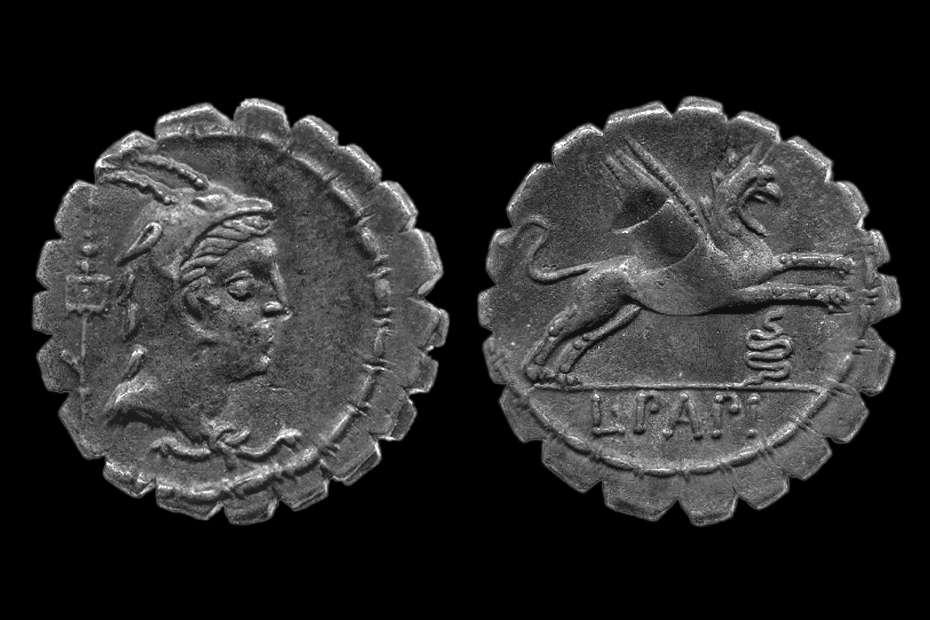
Set III-2-gry-001. In Greek and Roman mythology, gryphon was a fantastic hybrid creature, with the body, tail, and legs of a lion and the head and wings of an eagle. Because the lion was traditionally considered the king of the beasts and the eagle the king of birds, the gryphon was thought to be an especially powerful and majestic creature, heraldically associated with the royalty. Gryphons were known for guarding treasures and thought to be living between the Arimaspians and Hyperboreans of the North-East Scythia.
------------------------------------------------- « ● Selected Classical Quotations ● » --------------------------------------------------
“ It is clear that gold exists in by far the greatest quantities to the north of Europe, but I cannot say with certainty how it comes to be there. It is reported that there are one-eyed men called Arimaspians who snatch it away from griffins, but I cannot believe in the existence of one-eyed men who are born that way, and who would still have in all other respects a nature just like that of other humans. In any case, these peripheral regions which surround and enclose the rest of the earth on all sides quite reasonably contain the very things we value as most beautiful and rare. „
● Herodotus (484-425 BC), Histories III: 116, 1-2 | Translated by Andrea L. Purvis & Robert B. Strassler. Copyright © 2007.
--------------------------------------------------------------------- « ● ● ● » ---------------------------------------------------------------------
“ Then there is Aristeas son of Kaystrobios of Proconnesus, who composed verses in which he claims to have been inspired by Phoibos Apollo and to have visited the land of the Issedones. Above the Issedones, he says, live the Arimaspians, one-eyed men; above them dwell the gold-guarding griffins; and above the griffins, the Hyperboreans, whose land extends all the way to the sea. {...} While the Issedones themselves are well known, we must rely on what they tell us for our knowledge of what lies beyond them - the one-eyed men and the gold-guarding griffins. It is from the Issedones that the Scythians have received their account. The rest of us, because we have heard it from the Scythians, customary call those people Arimaspians, which is a Scythian word. For the Scythians use the word arima for "one" and spou for "eye". „
● Herodotus (484-425 BC), Histories IV: 13, 1; 27, 1 | Translated by Andrea L. Purvis & Robert B. Strassler. Copyright © 2007.
--------------------------------------------------------------------- « ● ● ● » ---------------------------------------------------------------------
“ Although he ruled as king of the Scythians, Skyles was not at all content to live as the Scythians did but, because of his education, was much more inclined to practice Hellenic customs. {...} he had a house in the city the Borysthenites [Pontic Olbia]. It was a vast and expensive property, surrounded by white stone statues of sphinxes and griffins. Well, the god hurled a thunderbolt at this house, which caused a fire that completely destroyed it. „
● Herodotus (484-425 BC), Histories IV: 78, 3; 79, 2 | Translated by Andrea L. Purvis & Robert B. Strassler. Copyright © 2007.
--------------------------------------------------------------------- « ● ● ● » ---------------------------------------------------------------------
“ The Samians took a tenth of their profits, six talents' worth, and had a bronze bowl made in the Argive style, with griffin heads projecting around it. „
● Herodotus (484-425 BC), Histories IV: 152, 4 | Translated by Andrea L. Purvis & Robert B. Strassler. Copyright © 2007.
--------------------------------------------------------------------- « ● ● ● » ---------------------------------------------------------------------
“ I have heard that the Indian animal the gryphon is a quadruped like a lion; that it has claws of enormous strength and that they resemble those of a lion. Men commonly report that it is winged and that the feathers along its back are black, and those on its front are red, while the actual wings are neither but are white. and Ctesias records that its neck is variegated with feathers of a dark blue; that it has a beak like an eagle's, and a head too, just as artists portray it in pictures and sculpture. Its eyes, he says, are like fire. It builds its lair among the mountains, and although it is not possible to capture the full-grown animal, they do take the young ones. And the people of Bactria, who are neighbours of the Indians, say that the gryphons guard the gold in those parts; that they dig it up and build their nests with it, and that the Indians carry of any that falls from them. The Indians however deny that they guard the aforesaid gold, for the gryphons have no need of it (and if is what they say, then I at any rate think that they speak the truth), but that they themselves come to collect the gold, while the gryphons fearing for their young ones fight with the invades. They engage too with other beasts and overcome them without difficulty, but they will not face the lion or the elephant. „
● Claudius Aelianus (175-235 AD), On the Characteristics of Animals IV: 27 | Translated by Alwyn F. Scholfield. Copyright © 1958-1959.
--------------------------------------------------------------------- « ● ● ● » ---------------------------------------------------------------------
“ Hesiod was the first to tell marvelous tales about griffins. „
● Anonymous, Scholium on Aeschylus' Prometheus Bound (in Catalogue of Women, LCL 503, Fragment № 100) | Translated by Glenn W. Most. Copyright © 2007.
--------------------------------------------------------------------- « ● ● ● » ---------------------------------------------------------------------
“ Round her [Nemesis'] throne flew a bird of vengeance, a griffin flying with wings, or balancing himself on four feet, to go unbidden before the flying goddess and show that she herself traverses the four separate quarters of the world {...} She [Nemesis] had harnessed racing griffins under her bridle; quick through the air she coursed in the swift car, until she tightened the curving bits of her four-footed birds {...} „
● Nonnus of Panopolis (late 300s-400s AD), Dionysiaca XLVIII: 381-385, 453-454 | Translated by William H. D. Rouse. Copyright © 1940.
| Editorial notes: {...} - Omitted text; [...] - Translation back to the original, clarification, or curator's commentary. |
|
|

 Search Functionality Demonstration