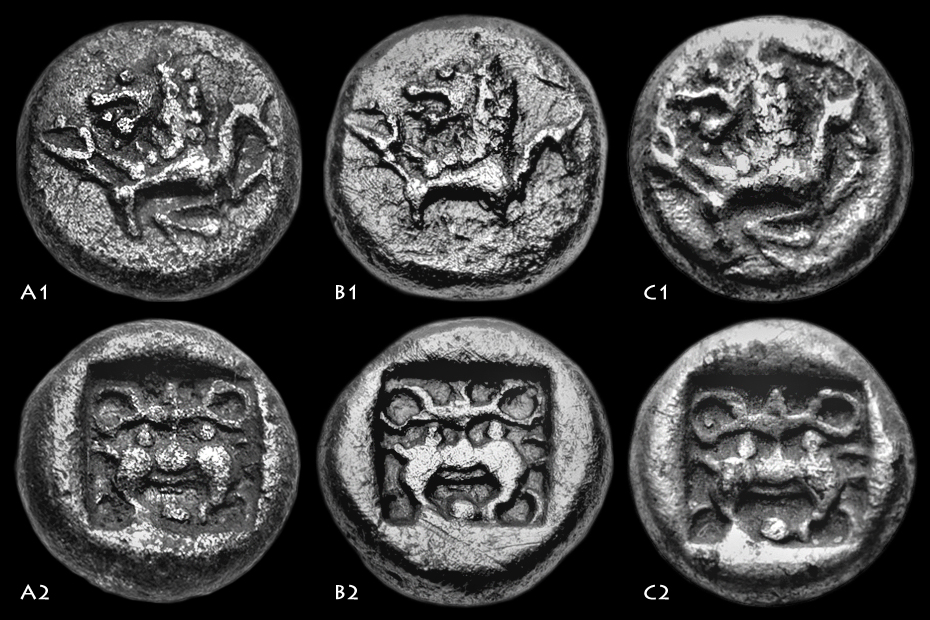
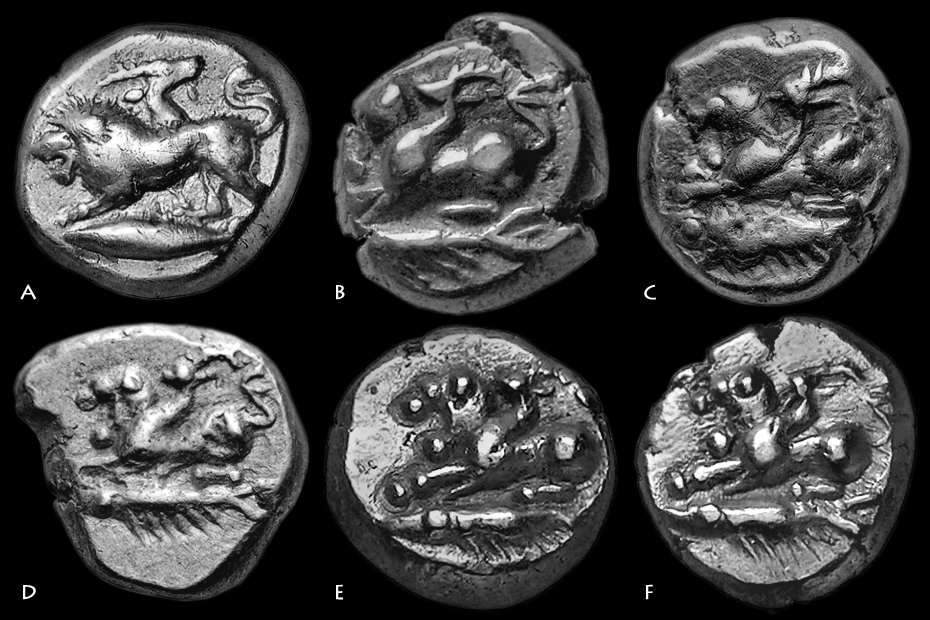
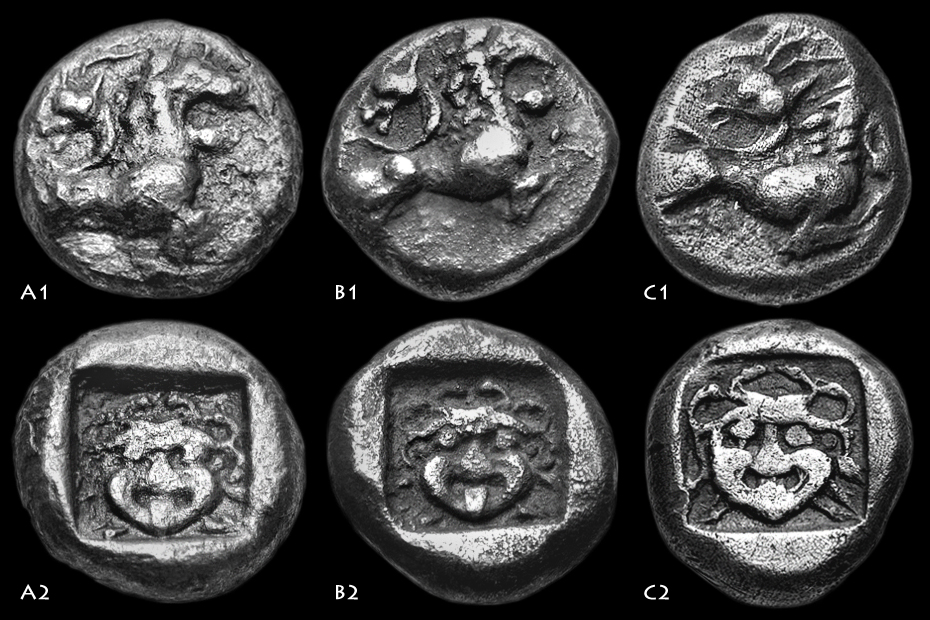
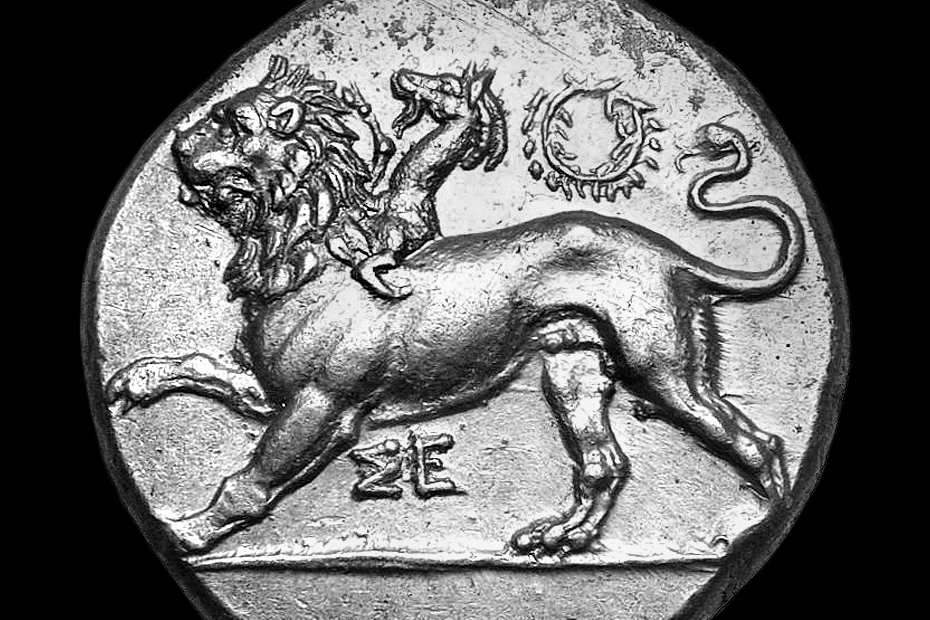
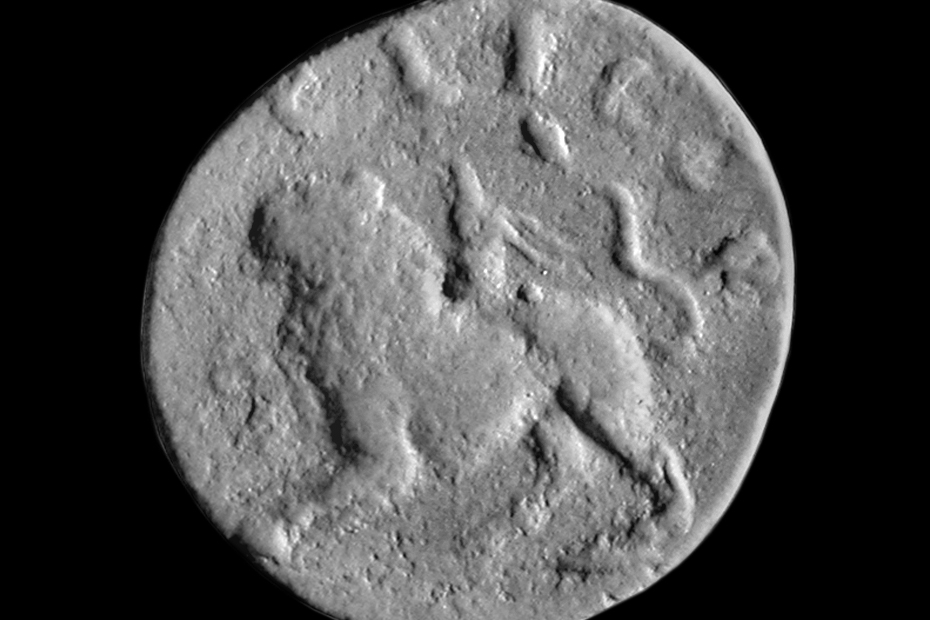
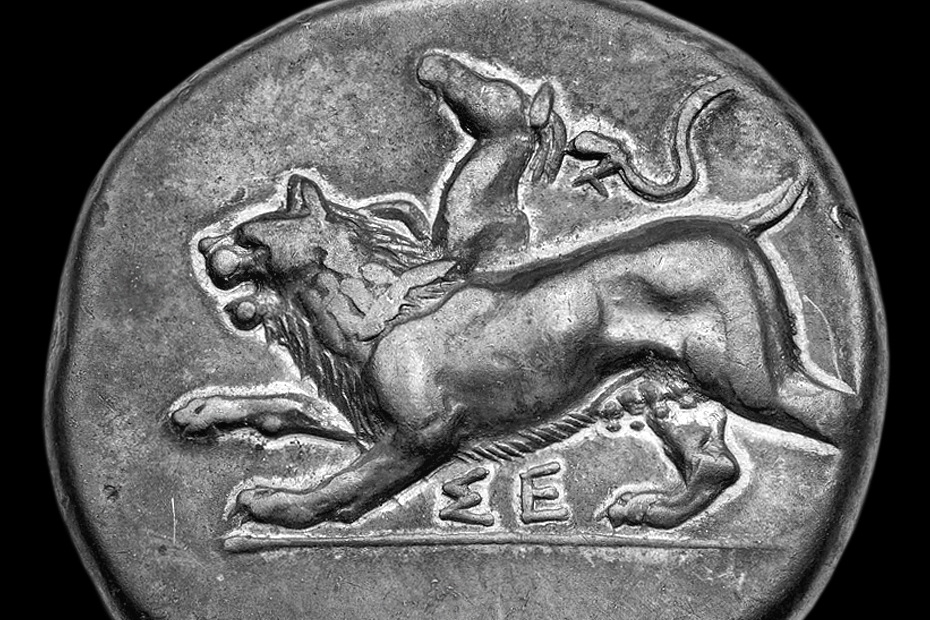
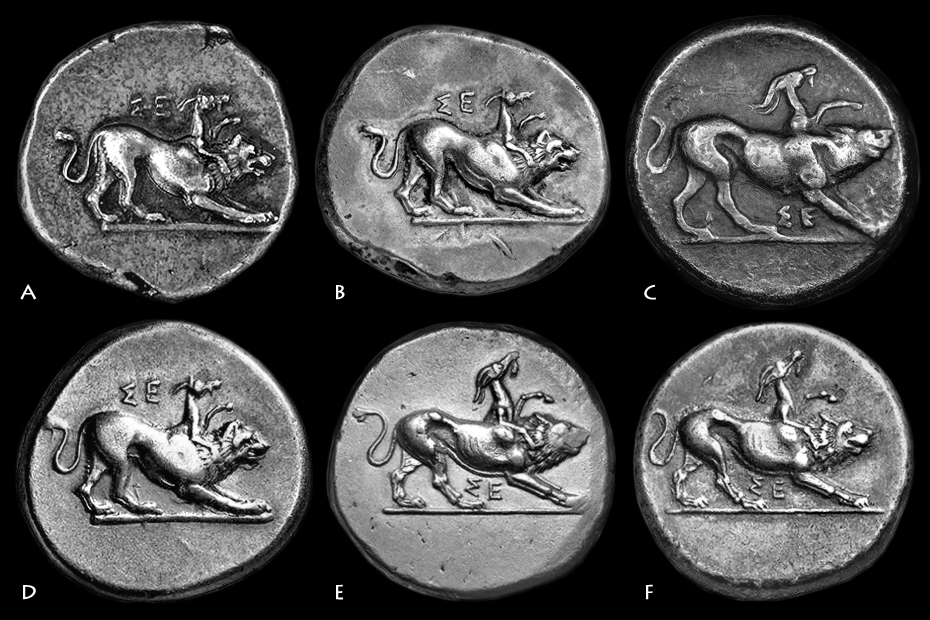
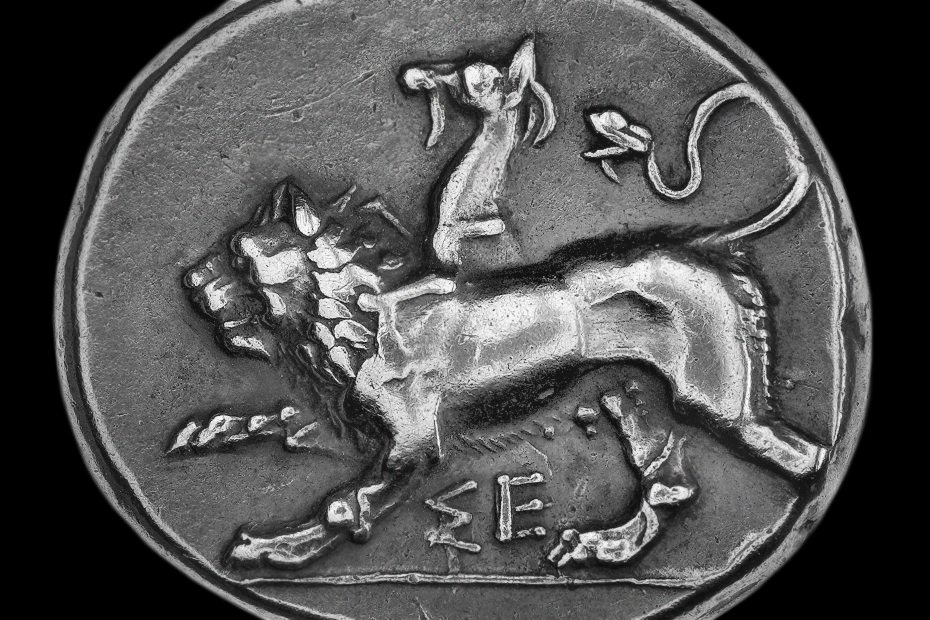
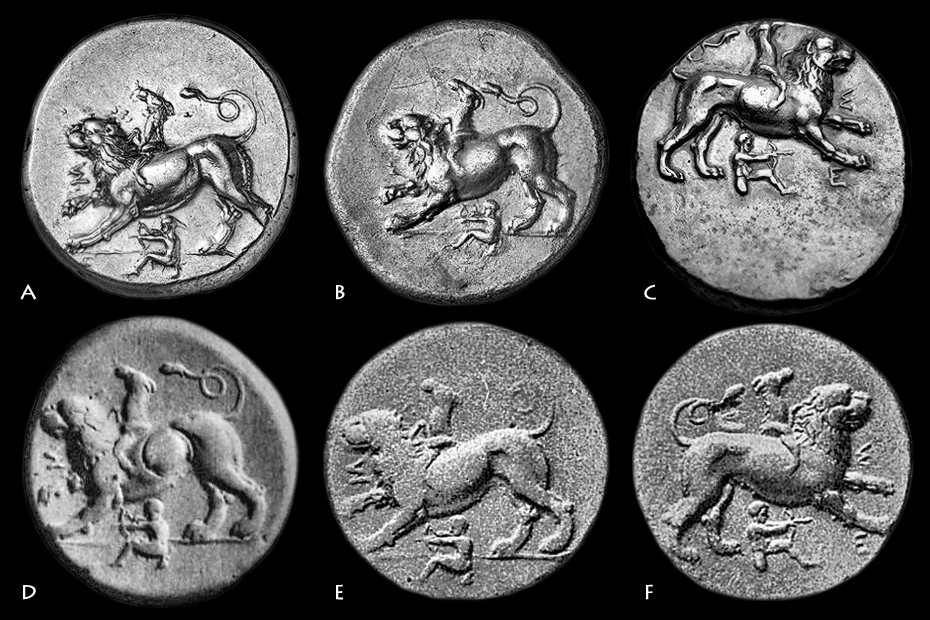
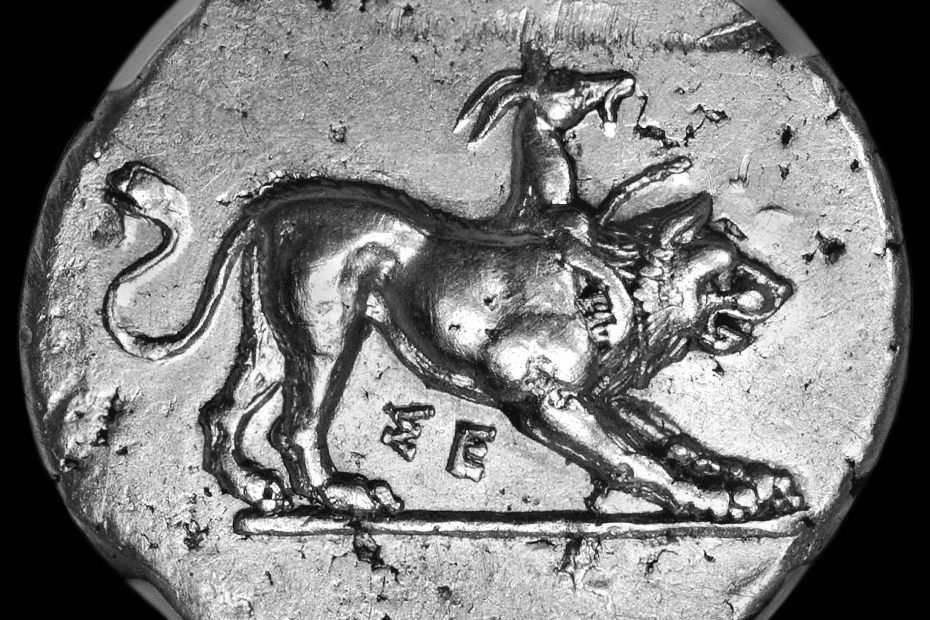
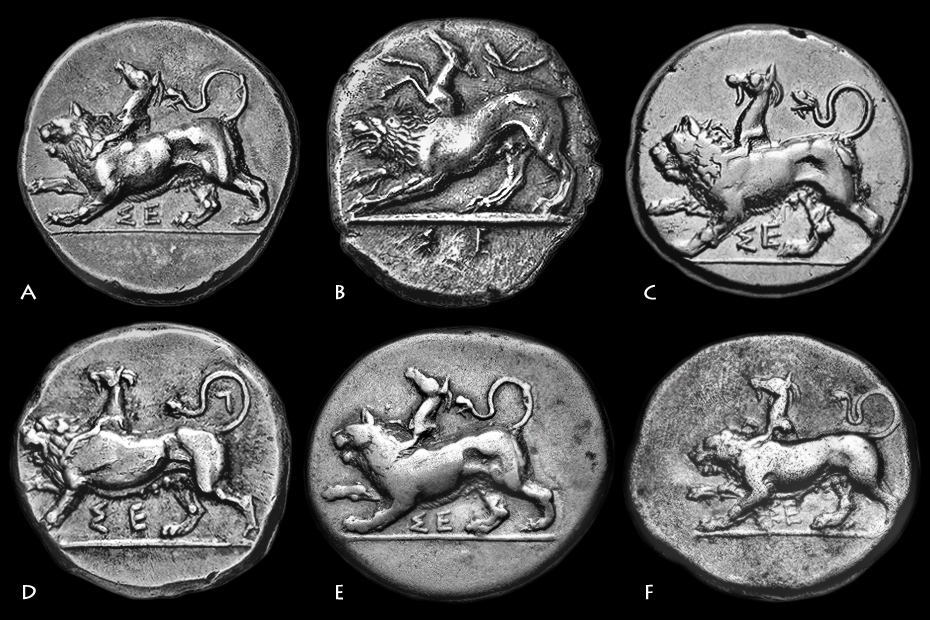
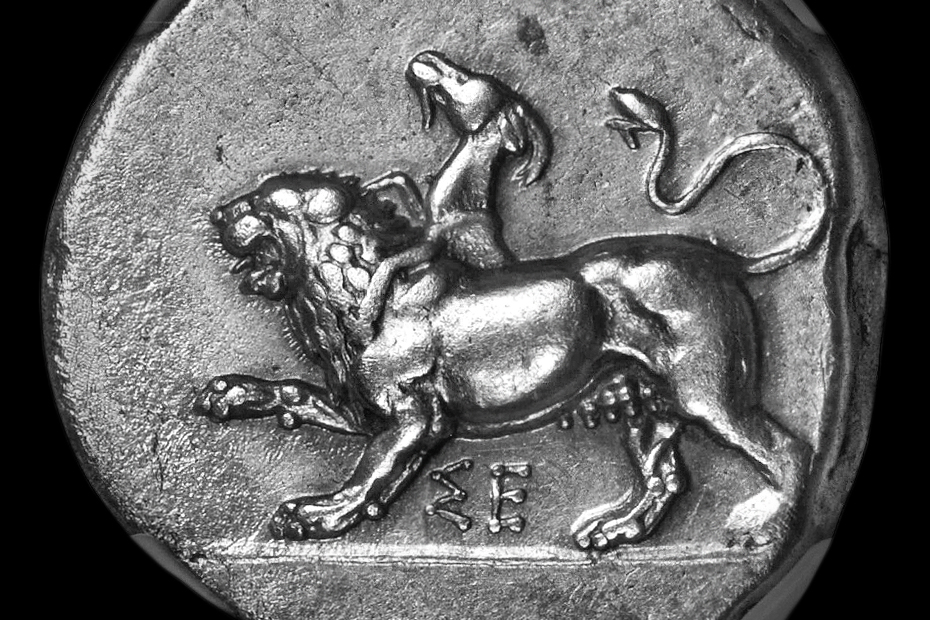
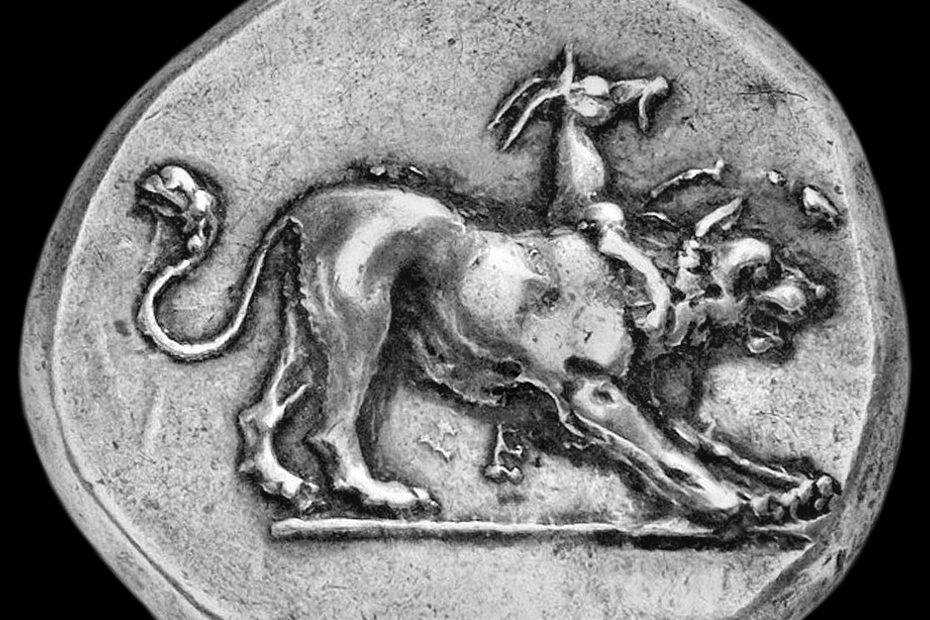
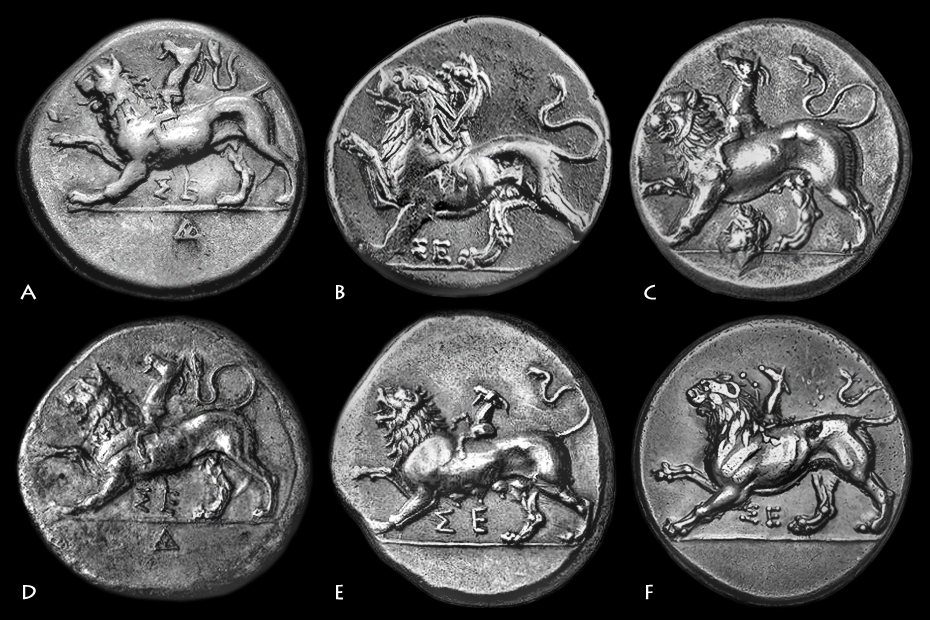
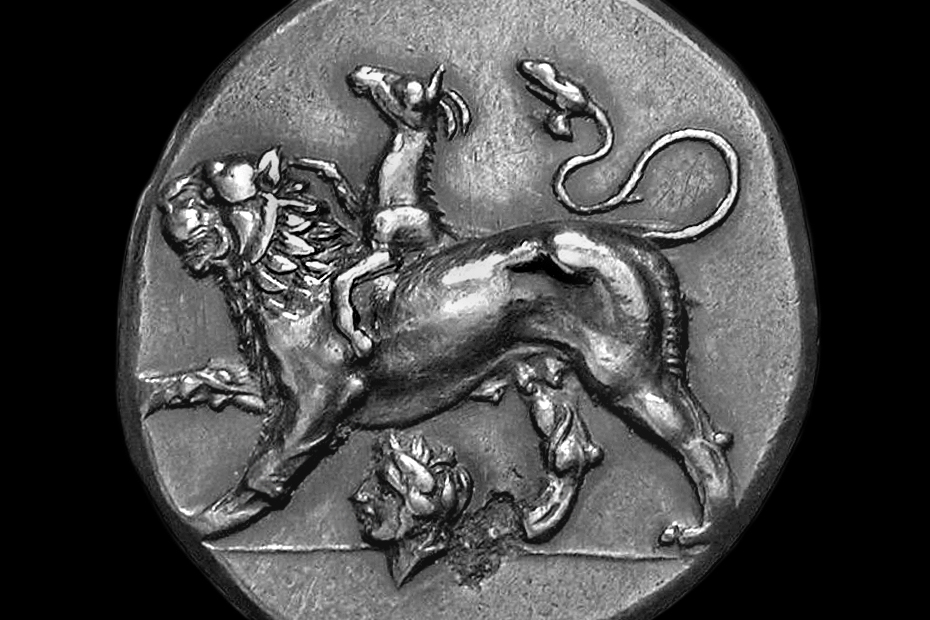
Set III-2-chi-001. In Greek mythology, Chimaera was a monstrous fire-breathing hybrid creature, composed of the parts of a lion and a goat, and with a tail terminating with snake's head. It was one of the offspring of Typhon and Echidna and a sibling of such monsters as Cerberos, Colchian Dragon, Ladon, Sphinx, Scylla, and Lernean Hydra. Sighting Chimaera was an omen of storms, shipwrecks, and natural disasters (particularly volcanoes). It was slayed by hero Bellerophon with help of the divine winged stallion Pegasus.
------------------------------------------------- « ● Selected Classical Quotations ● » --------------------------------------------------
“ When he had deciphered the fatal message from his son-in-law, the King's first step was to order Bellerophon to kill the monstrous Chimaera, a creature whom the gods had foisted on mankind. She had a lion's head, a serpent's [δράκων] tail, and the body of a goat; and her breath came out in terrible blasts of burning fire. „
● Homer (700s-600s BC), Iliad VI: 178-183 | Translated by Emile V. Rieu. Copyright © 1950.
--------------------------------------------------------------------- « ● ● ● » ---------------------------------------------------------------------
“ She [Echidna?] bore Chimaera, who breathed awful fire, three-headed, frightening, huge, swift-footed, strong, one head a bright-eyed lion's, one a goat's, the third a snake's [ὄφις], a mighty dragon-head [δράκων]. Noble Bellerophon and Pegasus caught her. „
● Hesiod (700s-600s BC), Theogony: 321-326 | Translated by Dorothea Wender. Copyright © 1973.
--------------------------------------------------------------------- « ● ● ● » ---------------------------------------------------------------------
“ And look at this one [Bellerophon] on a horse with wings [Pegasos]. He is killing the mighty-bodied fire-breathing monster [Chimaera]. „
● Euripides (480-406 BC), Ion: 201-204 | Translated by Ronald Frederick Willetts. Copyright © 1958.
--------------------------------------------------------------------- « ● ● ● » ---------------------------------------------------------------------
“ {...} the fire-breathing Chimaera {...} „
● Diodorus Siculus (90-30 BC), Historical Library VI: 9, 1 | Translated by Charles H. Oldfather. Copyright © 1933-1954.
--------------------------------------------------------------------- « ● ● ● » ---------------------------------------------------------------------
“ {...} the flame-throwing Chimaera {...} „
● Publius Vergilius Maro (70-19 BC), Aeneid VI: 288 | Translated by Cecil Day-Lewis. Copyright © 1952.
--------------------------------------------------------------------- « ● ● ● » ---------------------------------------------------------------------
“ Turnus himself, of magnificent build, bearing his weapons moved amongst the leaders, a head higher than they. Upon his triple-crested, tall helmet a Chimaera was rampant, breathing out volcanic fire from its jaws; the bloodier waxed the battle, the more did that creature appear to roar and rage, to go berserk and shoot forth glowering flames. „
● Publius Vergilius Maro (70-19 BC), Aeneid VII: 783-788 | Translated by Cecil Day-Lewis. Copyright © 1952.
--------------------------------------------------------------------- « ● ● ● » ---------------------------------------------------------------------
“ {...} Lycia, home of the monstrous Chimaera {...} „
● Publius Ovidius Naso (43 BC - 17/18 AD), Metamorphoses VI: 339 | Translated by David Raeburn. Copyright © 2004.
--------------------------------------------------------------------- « ● ● ● » ---------------------------------------------------------------------
“ {...} Chimaera, the monster with fire in its belly, the breast and head of a lion and the tail of a serpent [serpens]. „
● Publius Ovidius Naso (43 BC - 17/18 AD), Metamorphoses IX: 647-648 | Translated by David Raeburn. Copyright © 2004.
--------------------------------------------------------------------- « ● ● ● » ---------------------------------------------------------------------
“ That which is said to have happened in Lycia sounds like a myth, yet it has some supporting testimony in the tales that are told. Amisodarus, as they say, whom the Lycians call Isaras, arrived from from the Lycian colony in the vicinity of Zeleia, bringing with him pirate ships, in command of which was Chimarrhus, a warlike man, bloodthirsty and brutal. He sailed in a vessel which had a lion as its figurehead at the prow, and a serpent [δράκων] at the stern. He did much evil to the Lycians, and it was not possible to sail the sea or even to live in the cities near the sea. This man Bellerophon slew, pursuing him with Pegasus as he was trying to escape. {...} Some, attempting to explain away the mythical element in this account, assert that {...} the Chimaera, as it was called, was nothing but a mountain facing the sun, and that it caused reflections of sunlight, fierce and fiery in the summer time, and by these, striking all over the plain, the crops were dried up; and that Bellerophon, sensing this, cut away the smoothest part of the precipice which mostly sent back the reflections. „
● Lucius Mestrius Plutarchus (46-120 AD), Moralia III, 247 F-248 A, 248 C: Bravery of Women IX: The Lycian Women | Translated by Frank Cole Babbitt. Copyright © 1931.
--------------------------------------------------------------------- « ● ● ● » ---------------------------------------------------------------------
“ Chimaera {...} was no easy prey for a multitude of men, let alone for one, seeing that it was a single creature which yet had the power of three, having the foreparts of a lion, the tail of a dragon [δράκων], and a third head in the middle - a goat's head, through which in breathed fire. The beast was devastating the land and destroying the cattle. It is said, furthermore, that this Chimaera was reared by Amisodaros, as Homer has stated also, and was the offspring of Typhon and Echidna, as Hesiod records. So Bellerophon climbed on to his winged horse, Pegasos, the offspring of Medusa and Poseidon, and soaring high into the air, killed the Chimaera by shooting arrows at it from above. „
● Pseudo-Apollodorus (100s AD?), Bibliotheca II: 3, 031-032 | Translated by Robin Hard. Copyright © 1997.
--------------------------------------------------------------------- « ● ● ● » ---------------------------------------------------------------------
“ From Typhon and Echidna came Gorgon; Cerberus; the snake [draco] that guarded the Golden Fleece at Colchis; Scylla (who had a woman's body above the waist, but a dog's below; she was killed by Hercules); the Chimaera; the Sphinx, who lived in Boeotia; the serpent [serpens] Hydra, who had nine heads and was killed by Hercules; and the serpent [draco] of the Hesperides. „
● Hyginus (100s AD?), Fabulae: Theogony | Translated by Stephen M. Trzaskoma. Copyright © 2007.
--------------------------------------------------------------------- « ● ● ● » ---------------------------------------------------------------------
“ The Giant Typhon and Echidna had the following children: Gorgon; the three-headed dog Cerberus; the serpent [draco] that guarded the apples of the Hesperides beyond Ocean; the Hydra that Hercules killed at the Spring of Lerna; the serpent [draco] that guarded the ram's fleece in Colchis; Scylla, who was woman above the waist, a fish below the waist, and had six dogs sprouting from her; the Sphinx, which lived in Boeotia; and the Chimaera in Lycia whose front part had the form of a lion, the rear that of a snake [draco], and the middle that of a goat itself. „
● Hyginus (100s AD?), Fabulae: 151, The Children of Typhon and Echidna | Translated by Stephen M. Trzaskoma. Copyright © 2007.
--------------------------------------------------------------------- « ● ● ● » ---------------------------------------------------------------------
“ The statue of Asklepios is half the size of Olympian Zeus at Athens, and made of ivory and gold; the inscription says it was made by Thrasymedes of Paros, son of Arignotos. He sits enthroned holding a staff, with one hand over the serpent's [δράκων] head, and a dog lying beside him. The carvings on the throne show the deeds of Argive divine heroes, Bellerophon and the Chimaira, and Perseus taking the head of Medusa. Over from the temple is where the ritual suppliants of the god go to sleep. „
● Pausanias (110-180 AD), Description of Greece II Corinth: 27, 2 | Translated by Peter Levi. Copyright © 1971.
--------------------------------------------------------------------- « ● ● ● » ---------------------------------------------------------------------
“ Poets and the compilers of ancient legends, among whom is Hecataeus the chronicler, may sing of the Hydra of Lerna, one of the Labours of Heracles; and Homer may sing of the Chimaera with three heads {...}, the monster of Lycia kept by Amisodarus the Lycian king for the destruction of many, of varied nature, and absolutely invincible. Now these seem to have been relegated to the region of myths. The amphisbaena however is a snake [ὄφις] with two heads, one at the top and one in the direction of the tail. When it advances, as need for a forward movement impels it, it leaves one end behind to serve as tail, while the other it uses as a head. Then again if it wants to move backwards, it uses the two heads in exactly the opposite manner from what it did before. „
● Claudius Aelianus (175-235 AD), On the Characteristics of Animals IX: 23 | Translated by Alwyn F. Scholfield. Copyright © 1958-1959.
| Editorial notes: {...} - Omitted text; [...] - Translation back to the original, clarification, or curator's commentary. |
|
|

 Search Functionality Demonstration