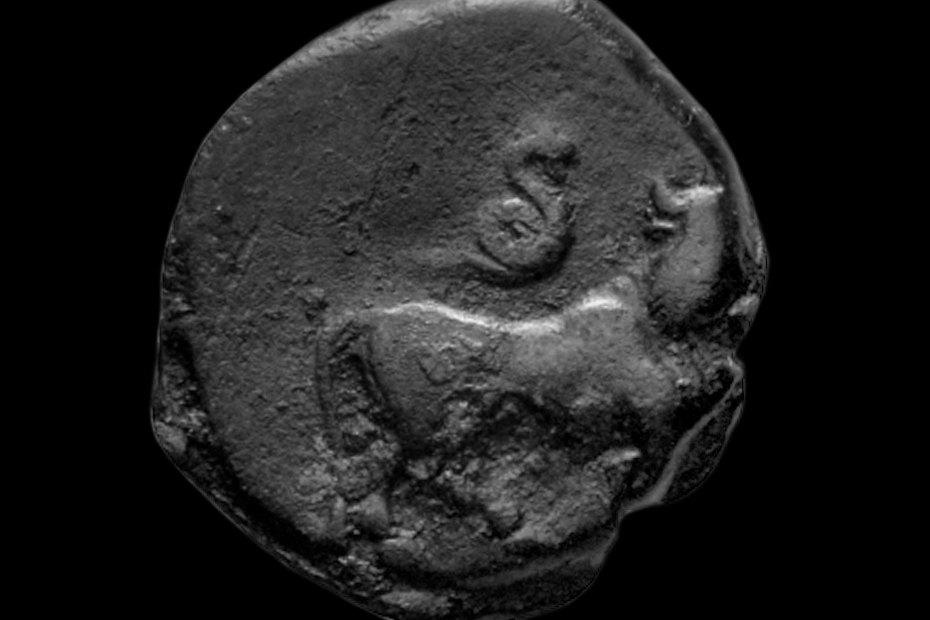
Set III-2-ach-001. In Greek mythology of the Archaic and Classical periods, Achelous was the god of all water and the rivers of the world. Later, in Hellenistic times, he was mostly relegated to the Achelous River, which is the largest river of Greece, and thus the chief of all river deities, every river having its own river spirit. Achelous was usually depicted as a stocky bull with the head of a bearded man with the prominent bovine ears and horns. He possessed the shape-shifting ability and could turn himself into a serpent.
------------------------------------------------- « ● Selected Classical Quotations ● » --------------------------------------------------
“ It was long ago that someone first said: You cannot know a man's life before the man has died, then only can you call it good or bad. But I [Deianeira] know mine before I've come to Death's house and I can tell that mine is heavy and sorrowful. While I still lived in Pleuron, with Oeneus my father, I conceived an agonizing fear of marriage. No other Aetolian woman ever felt such fear, for my suitor was the river Acheloüs, who used to come to ask my father for may hand, taking three forms - first, clearly a bull, and then a serpent [δράκων] with shimmering coils, then a man's body but a bull's face, and from his clump of beard whole torrents of water splashed like a fountain. I had to think this suitor would be my husband and in my unhappiness I constantly prayed for death before I should ever come to his marriage bed. But, after a time, to my joy there came the famous Heracles, son of Alcmena and Zeus. In close combat with Acheloüs, he won the contest and set me free. I do not speak of the manner of their struggles, for I do not know. Someone who watched the spectacle unafraid could tell. „
● Sophocles (497/496-406/405 BC), The Women of Trachis: 001-023 | Translated by Michael Jameson. Copyright © 1957.
--------------------------------------------------------------------- « ● ● ● » ---------------------------------------------------------------------
“ O Cephisus [the river-god], her [Creusa's] bull-shaped ancestor, what viper [ἔχιδνα] or what serpent [δράκων] glancing out a deadly flame of fire did you beget in her, this woman who will balk at nothing {...} „
● Euripides (480-406 BC), Ion: 1261-1264 | Translated by Ronald Frederick Willetts. Copyright © 1958.
--------------------------------------------------------------------- « ● ● ● » ---------------------------------------------------------------------
“ But Heracles, desiring to do a service to the Calydonians, diverted the river Achelous, and making another bed for it he recovered a large amount of fruitful and which was now irrigated by this stream. Consequently certain poets, as we are told, have made this deed into a myth; for they have introduced Heracles as joining battle with Achelous, the river assuming the form of a bull, and as breaking off in the struggle one of his horns, which he gave to the Aetolians. „
● Diodorus Siculus (90-30 BC), Historical Library IV: 35, 3-4 | Translated by Charles H. Oldfather. Copyright © 1933-1954.
--------------------------------------------------------------------- « ● ● ● » ---------------------------------------------------------------------
“ To the east of it [the Zakynthos Island] and Kephallenia are situated the Echinades Islands. {...} Formerly they were in the open sea, but the great amount of silt brought down has joined some of them to the mainland, and will do so to others. This territory was called Paracheloitis ["Among the Acheloos"], since the river overflows it, creating a matter of contention in antiquity, as it confused the boundaries that had long existed between the Akarnanians and the Aetolians. They would decide it by weapons as they did not have arbitrators, and the more powerful would win. This is the reason for the creation of a certain myth that Herakles defeated acheloos and as the prize of winning the victory married Deianeira the daughter of Oeneus, whom Sophocles made to say the following: "My suitor was the river, I mean Acheloos, who in three shapes would demand me from my father, coming to me in bodily form as a bull, and then as a glittering coiled serpent [δράκων], and then with the trunk of a man and the face of an ox." Some add to this, saying that it was the horn of Amaltheia, which Herakles broke off from Acheloos and gave to Oeneus as a wedding gift. Others, conjecturing the truth from it, say that the Acheloos, like other rivers, was believed to be like a bull from its sound and the winding of its streams (which were called horns), like a serpent [δράκων] because of its length and twisting, and "with the face of an ox" for the same reason as "bull faced". Herakles, who generally performed good deeds, especially for Oeneus (because of the marriage alliance), constrained the problems in the flow of the river by means of embankments and channels, and thus, to the pleasure of Oeneus, he gave relief to much of Paracheloitis, and this was the horn of Amaltheia. „
● Strabo (64/63 BC-24 AD), Geography X: 2, 19 | Translated by Duane W. Roller. Copyright © 2014.
--------------------------------------------------------------------- « ● ● ● » ---------------------------------------------------------------------
“ I, Achelous, possess the power to alter my shape in a limited number of ways, young Theseus. Sometimes I am as you see me now; sometimes I change to a serpent [anguis] or lead the herd as a strong-horned bull - or did when I could. „
● Publius Ovidius Naso (43 BC - 17/18 AD), Metamorphoses VIII: 879-882 | Translated by David Raeburn. Copyright © 2004.
--------------------------------------------------------------------- « ● ● ● » ---------------------------------------------------------------------
“ Since I [Achelous] was weaker in manly strength, I turned to my own arts, slithering out of the hero's grasp in the form of a long snake [anguis]. My body was looped into sinuous coils and I flickered my forked tongue, hissing the fury. But Hercules laughed and made fun of my magic: "Dealing with snakes [anguis] is a task I used to perform in my cradle! You may surpass other snakes [draco], Achelous, but really, a single serpent [serpens] is hardly a threat when compared with the Hydra of Lerna. That monster [echidna] blossomed and throve on its wounds; when one of its numerous heads was cut off, it always recovered by sprouting another two heads in its place. Destruction caused it to grow, as it put forth branches of vipers [coluber] sprung from the carnage. But I, great Hercules, mastered the creature and cauterized each neck as I loped it. What do you think will happen to you, who are merely disguised as a snake [anguis], in dubious form, with weapons not yours by nature?" He then proceeded to shackle the top of my neck in his fingers. Helplessly choking, as if my throat had been gripped by pincers, I struggled to tear my jaws away from his strangling thumbs; but once again I was beaten. I still had a third shape left, so I changed once more to a savage bull and returned to the fray. „
● Publius Ovidius Naso (43 BC - 17/18 AD), Metamorphoses IX: 062-080 | Translated by David Raeburn. Copyright © 2004.
--------------------------------------------------------------------- « ● ● ● » ---------------------------------------------------------------------
“ The Megarians from the borders of Attica have built a treasury [at Olympia] and consecrated offerings in it: little cedar figures inlaid with gold, of Herakles' fight with Acheloos. There are Zeus and Deianeira, Acheloos and Herakles, and Ares helping Acheloos, and there used to be a statue of Athena standing there because she was Herakles' ally; this is now beside the Hesperides in the temple of Hera. „
● Pausanias (110-180 AD), Description of Greece VI Eleia II: 19, 12 | Translated by Peter Levi. Copyright © 1971.
--------------------------------------------------------------------- « ● ● ● » ---------------------------------------------------------------------
“ {...} they sing of horned Acheloös, when Heracles cut off his horn and took it to adorn his wedding. „
● Nonnus of Panopolis (late 300s-400s AD), Dionysiaca XVII: 238-239 | Translated by William H. D. Rouse. Copyright © 1940.
--------------------------------------------------------------------- « ● ● ● » ---------------------------------------------------------------------
“ {...} Deianeira, who once in that noisy strife for a bride preferred Heracles, and stood there fearing the wedding with a fickle bullhorn River [Achelous]. „
● Nonnus of Panopolis (late 300s-400s AD), Dionysiaca XLIII: 012-015 | Translated by William H. D. Rouse. Copyright © 1940.
| Editorial notes: {...} - Omitted text; [...] - Translation back to the original, clarification, or curator's commentary. |
|
|

 Search Functionality Demonstration